

- Mastering pruning and training techniques is essential for optimising your cannabis grow and achieving abundant, high-quality harvests. If you’ve already completed a few grows and mastered the fundamentals of this noble art, it might be time to level up your expertise. In this article, we guide you through several advanced techniques, such as mainlining and spiral LST, to help you shape the structure of your cannabis plants with more precision.
Why Use Advanced Growing Techniques?
If you're an experienced grower, you'll know that pruning your cannabis plants isn't just about snipping a few leaves here and there - this is a strategic practice that directly affects how your plants grow and develop. When done correctly, pruning and training techniques can offer a wide range of benefits:
- They increase light penetration in the lower parts of the plant. They improve airflow and help prevent mould and fungal issues.
- They promote uniform bud distribution.
- They help manage plant height, which is useful for indoor grows with space constraints or outdoor grows that require discretion.
- They help maximise the plant's yielding capacity.
MainLining (a.k.a. Manifolding)
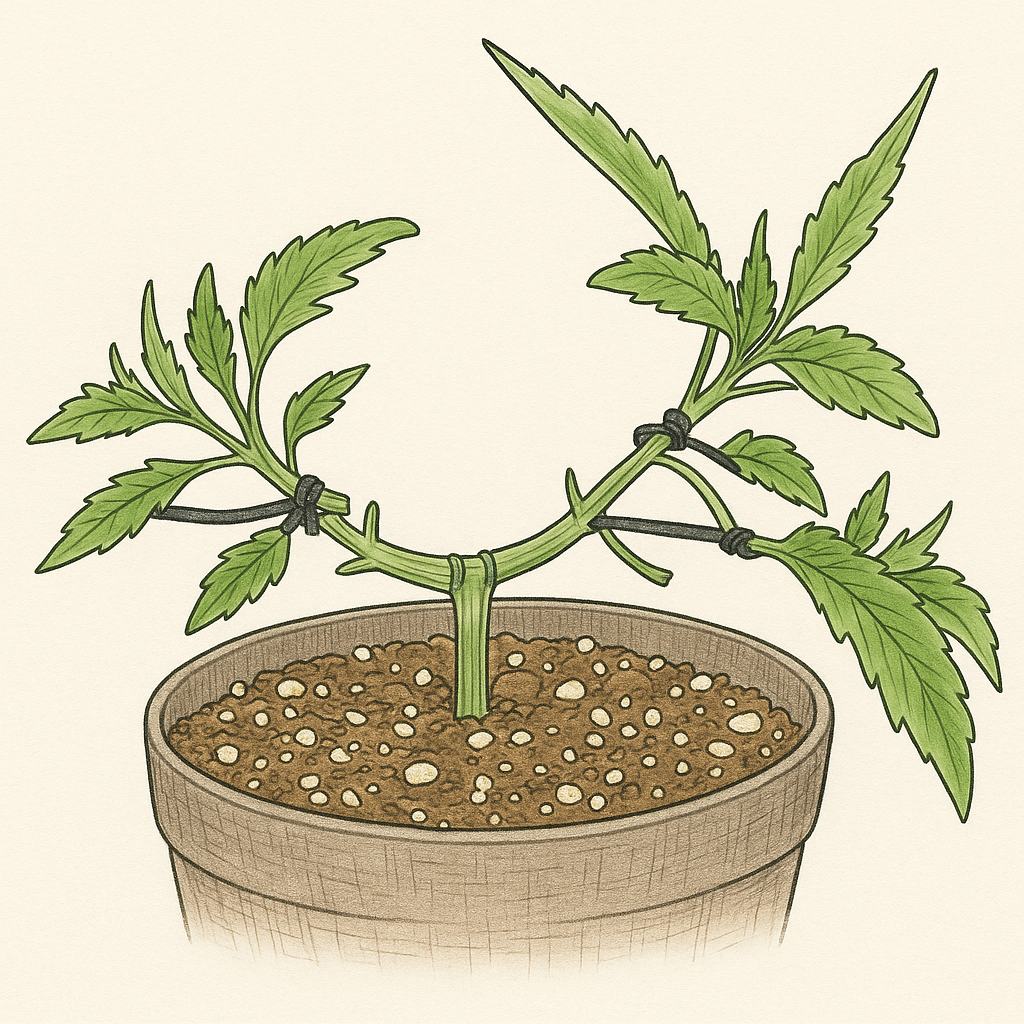
Mainlining is a technique that combines topping, low stress training (LST), and the removal of the lower branches. The goal is to create a symmetrical central structure starting from the plant's first node, allowing the growth to be evenly split into multiple main colas that receive equal access to light.
Advantages of Mainlining
Mainlining is a powerful way to design your plant's morphology. Here's why many expert growers opt for this method:
Symmetrical structure for optimal plant architecture:
- As you train the plant from a single central point, the branching develops evenly, creating multiple colas that receive equal amounts of light, air, and nutrients. Imagine a plant that doesn't have the typical dominant central cola with several smaller side buds, but instead has several main branches that produce massive colas - a dream for any cannabis enthusiast!
- Increased light exposure: Thanks to the plant's "Y-shaped" structure, each branch gets direct light, resulting in denser and more resinous buds.
- More uniform harvests: Buds develop to a similar size and shape, offering a more homogeneous and high-quality yield.
- Open structure: This makes it easier to perform maintenance tasks like defoliation, pest control, or foliar feeding. It also helps to improve the airflow, which in turn reduces the risk of mould and fungi.
- This technique promotes horizontal growth and limits vertical height, so it's ideal for maximising yields in small spaces.
Step-by-Step Guide on How to Mainline Cannabis Plants
- Wait until your plant has developed 5 or 6 nodes; then cut the main stem just above the third node.
- Remove everything below the third node (leaves and shoots included), leaving only the shoots at the third node.
- Carefully tie down these two branches horizontally to create a "Y" shape.
- Let each branch grow four new nodes. Then, repeat the same procedure and top each new branch just above the third node. This time, remove only the shoots and leaves of the second internode, leaving the first and third internodes intact.
- Adjust the ties as needed to keep the two main branches parallel to the ground.
Continue growing the plant as usual. You'll soon see eight beautiful colas forming, which will translate into a generous harvest of buds like fists.
Spiral LST
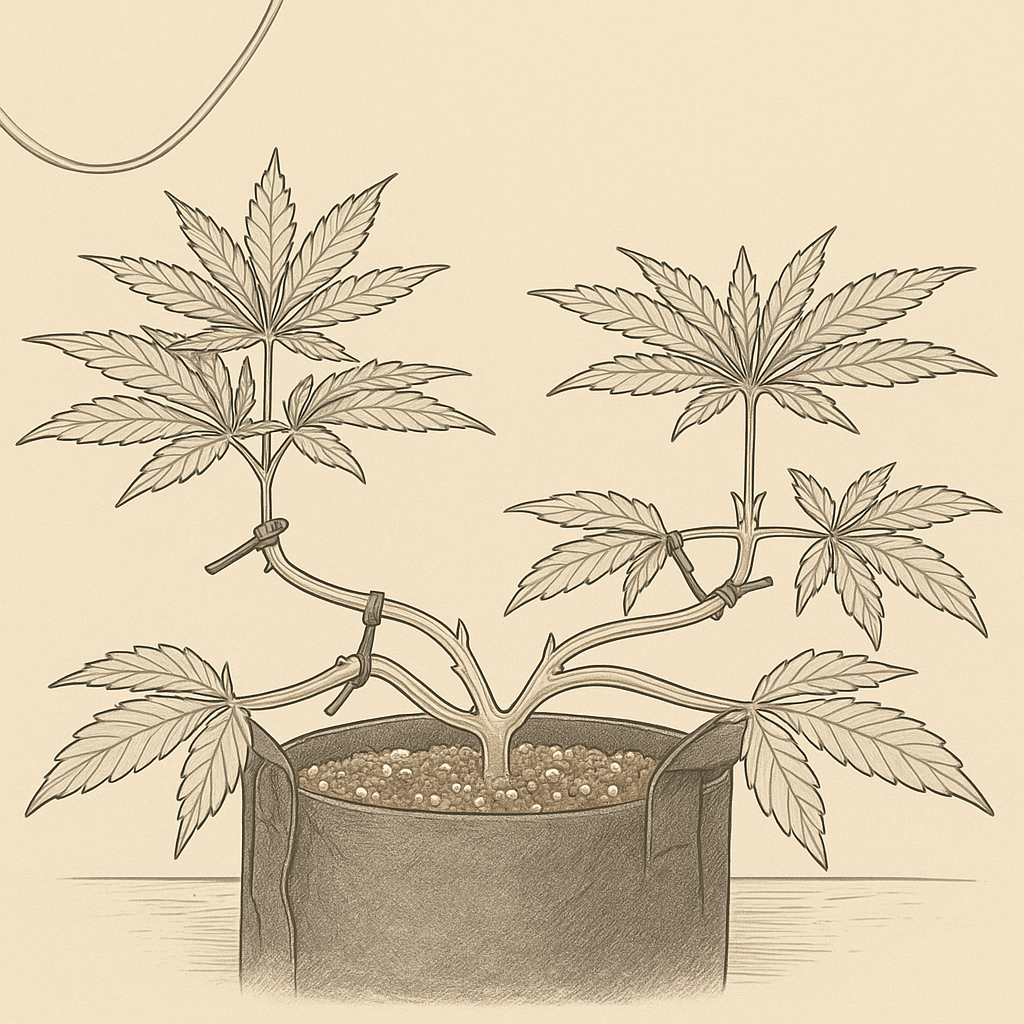
Spiral LST is a variant of the Low Stress Training technique (LST) that involves guiding your cannabis plant so it grows in a spiral shape. As incredible as it may sound, shaping your plant like a spiral staircase is not only possible - it's also an effective strategy to ensure all branches receive maximum light exposure.
How to Apply Spiral LST
Spiral LST should be started in the early stages of the plant's life, when it has between 3 and 5 nodes.
- Gently bend the main stem and guide it in a circular, spiral shape around the edge of the pot, securing it gradually as it grows.
- Anchor new shoots to the soil using garden ties or LST clips - just be sure to do it slowly and gently to avoid causing excessive stress to the plant.
- Continue this circular pattern from the outside in, creating a spiral as the plant recovers and grows.
- This method ensures the entire structure is exposed to light evenly, which increases both bud quality and quantity.
Maintenance tip: Check your plant regularly to ensure all side branches are receiving enough light. Adjust your ties or clips as needed to correct the shape.
Benefits of Spiral LST
- Space optimisation: Ideal for indoor grows in tight spaces, as it allows you to control vertical height whilst expanding the plant horizontally.
- Better light exposure
- Higher yielding capacity
Top Tips for the Successful Implementation of Spiral LST
Be patient and gentle: This technique requires time and close attention to properly guide the plant's growth. If you're the type who can't wait to fill your stash jar with fragrant buds, you might be better off with faster alternatives like autoflowering strains.
Avoid damage: It's crucial to handle the plant carefully to avoid snapping stems or branches during training. This is not about forcing your plant - it's about gently guiding it into the shape you want. A broken branch can become a gateway for mould and other infections, so don't take any chances.
Learning more advanced techniques doesn't just take your grow to the next level - it's also a fun and rewarding process. And don't forget: this is not only about growing great cannabis but also about enjoying the journey!
Comments from our readers
There are no comments yet. Would you like to be the first?
Leave a comment!Did you like this post?
Your opinion about our seeds is very important to us and can help other users a lot (your email address won't be made public).